MyPain.ca
MyPain.ca

Patient Education Initiative

MyPain.ca
  • Chronic Pain

Trigeminal Neuralgia

  • June 12, 2011
  • Dr. Kevin Rod

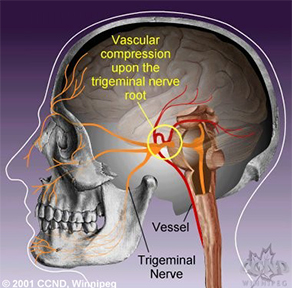
TRIGEMINAL NEURALGIA or TN is a very disturbing chronic pain condition. The pain of Trigeminal Neuralgia is felt on one side of face. It is usually a series of sharp pain attacks that can last form a few seconds to a couple of minutes. The main difference of this pain from other causes of face pain like Post Herpetic Neuralgia is the consecutive nature of pain in a series of sharp pain attacks compared to constant pain in other conditions. Trigeminal nerve is the fifth cranial nerve that comes out of brain and exits the skull at the base of skull, coming into the face. It is a sensory nerve and is divided into three branches: Ophthalmic, Maxillary and Mandibular. Each branch gives sensation to one part of the face from forehead to mid face and lower part of the face. It is believed that this nerve may get compressed by an artery that is very close to it on its path. This compression may cause damage to the covering of the nerve. Damaged nerves may send pain signals to brain instead of sensory signals. Trigeminal nerve’s covering may become compressed by other reasons like tumours, or become damaged secondary to other diseases like MS.


Diagnosis of Trigeminal Neuralgia is through proper history taking, paying attention to the nature of the pain, proper physical examination to rule out other causes and some diagnostic tests like: MRI of brain to rule out tumors or MS and MRA (magnetic resonance Angiography) to observe the nerve compression by the artery.

Treatment of Trigeminal Neuralgia can be by medication, injections or surgery. Anti-epileptics and Anti-depressants can help to control pain in many patients. If medications are not enough, injection of a chemical substance to block or kill the nerve may be helpful but can leave some numbness on the face. Radiation and Vascular surgery may be needed to control the pain in sever cases that do not respond to other treatments. Of all the different treatment options, vascular surgery is the most invasive treatment and has the highest success rate for prevention of pain recurrence.

Over the years, I have dealt with many patients who suffer from this condition. I have seen the enormous suffering they have to go through each day of their life. Patients need to know that early treatments would provide better outcomes than late interventions. So, inform yourself and see your doctor as soon as the pain starts.


Dr. Kevin ROD –  Toronto Poly Clinic

Related Topics
  • Chronic Pain
  • Pain Management
  • Treatment
Previous Article
  • Chronic Pain
  • Remedies

Chronic Pain Treatment

  • June 11, 2011
  • Dr. Kevin Rod
View Post
Next Article
  • Chronic Pain

Phantom Limb Pain

  • June 17, 2011
  • Dr. Kevin Rod
View Post

Leave a Reply Cancel reply

You must be logged in to post a comment.

ZENDOSE Tweets
Tweets about @Drkevinrod


You can use this site for a Mind Body Wellness program free of charge.

Contact Me to learn how.


This blog is for sharing ideas among us. Simply "Login" using your Facebook, Google or Twitter account and comment and share your ideas in the comments section.

>> Visit Presentation Slide page

Recent Posts
  • Dr. Kevin Rod on theZoomer talks about pain and graceful aging
  • Pain Reprocessing Therapy (PRT)
  • Elbow Exercises
  • Wrist Exercises
  • Anti-Inflammatory Diet to Help Ease Chronic Pain
Recent Comments
  • Why Your Illness Doesn’t Define You - Seeking Serenity and Harmony on Disuse Syndrome and Chronic Pain
  • What is the relationship of Mental Health and Chronic Pain or Chronic Conditions? – Toronto Poly Clinic on What is the relationship of Mental Health and Chronic Pain or Chronic Conditions?
  • Guest Post: How to deal with a difficult diagnosis on Disuse Syndrome and Chronic Pain
  • when i cough my pubic area hurts – Ascharters on PELVIC PAIN, WHY DO WE GET CHRONIC PELVIC PAIN?
  • why does my groin area hurt female – Ascharters on PELVIC PAIN, WHY DO WE GET CHRONIC PELVIC PAIN?
Check out the Archives
MyPain.ca
Patient Education Initiative

Input your search keywords and press Enter.